Sunflower in 84 Days
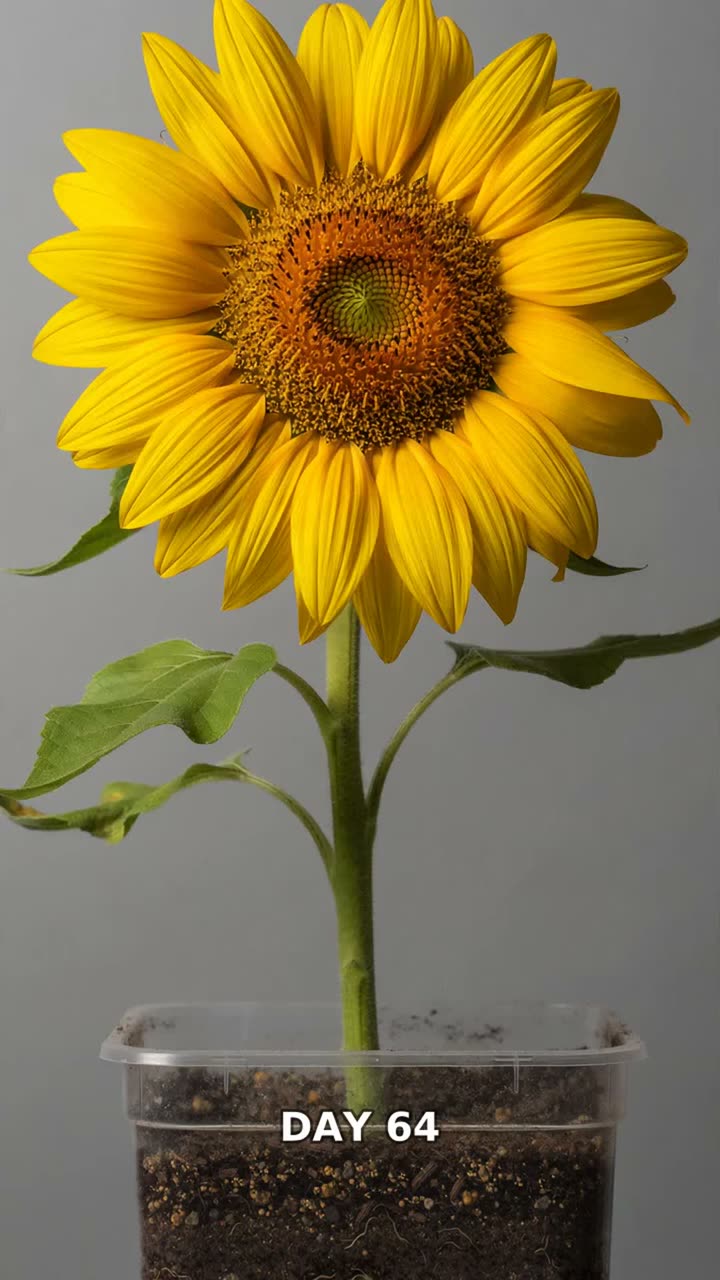
No plant in this series changes as fast, or as visibly, as a Mammoth sunflower. The Grow Through Time film follows one plant for 84 days: a striped seed, a two-leaf seedling, a stalk that seems to grow while you watch, a bud the size of a fist, and then a giant yellow head in full bloom. This page explains what drives that speed — and what a real Mammoth needs to get close to it.
The honesty note: 84 days is the AI time-lapse’s own span. It sits inside the real range for Mammoth types — seed houses put Russian Mammoth at about 80 days to bloom — but your calendar will shift with soil warmth, day length and water. Treat it as a realistic target in a warm, sunny season, not a guarantee.
Stage by stage: seed to bloom
| Stage | In the film | What you see |
|---|---|---|
| Germination | Day 1–10 | In the film, the seed coat splits, a taproot dives, and folded seed leaves push up. |
| Seedling | Around Day 10–25 | In the film, seed leaves open, rough-edged true leaves appear, and the head begins tracking the sun. |
| Rapid vegetative growth | Around Day 25–55 | In the film, by around Day 40 the stalk thickens daily and height gain becomes the whole story. |
| Bud formation | Around Day 55–70 | In the film, height growth slows as a single large bud forms at the top, wrapped in green bracts. |
| Bloom | Around Day 70–84 | In the film, yellow petals unfold around the dark disk until, by Day 84, the head is in full bloom. |
| Seed maturation (after the film) | Weeks after bloom | Petals fall, the head droops, its back yellows, and striped seeds harden inside. |
Sowing: direct, deep enough, after frost
Mammoth sunflowers prefer to be sown where they will grow. Sow Right Seeds advises planting 1 inch deep after all danger of frost, sowing 2 to 3 seeds per spot and thinning to the strongest seedling. That depth keeps the large seed moist and hidden from birds. Sow Right puts germination at 7 to 14 days, with ideal soil at 70 to 75°F and pH 6.0 to 7.5. Seeds ’n Such gives 7 to 10 days for Russian Mammoth at the same depth. Both agree: cold soil is the enemy of a fast start.
You can start seed indoors, but the window is short: Sow Right warns that sprouted sunflowers must go outside within 2 to 3 weeks, because the long taproot quickly bottoms out a pot and stunts growth. Use biodegradable pots you can plant whole. For most gardeners, direct sowing is simpler. The root-first pattern in the film is explained in Bean Germination Stages, Day by Day.
Sun, spacing and the taproot
The name “sunflower” is a growing instruction. Sow Right states that Mammoths need full sun — six hours minimum, eight recommended for the biggest growth — and warns they will shade out other plants, so site them at the back or north side of a bed. Young heads track the sun across the day; older, heavy heads stop moving. That tracking is real biology, not a film effect.
Spacing decides head size. Sow Right advises at least 18 inches between Mammoth plants, and up to 36 inches for the largest heads, noting that crowded plants produce smaller heads and a Mammoth stalk carries a single flower. Seeds ’n Such recommends 18 to 24 inches for Russian Mammoth, with heads of 10 to 14 inches on plants averaging 10 to 12 feet and reaching up to 16 feet in favorable conditions. Sow Right puts the ceiling at 12 feet — a reminder that seed-house figures describe potential, not a promise.
Water with the taproot in mind: Sow Right advises deep, infrequent watering, letting the soil dry between waterings so the taproot grows deep. Shallow watering produces a shallow-rooted plant a summer wind can rock loose — a real risk for a 10-foot stalk with a heavy head. Add supports early, in windy sites, so you do not damage roots later.
After the bloom: the half the film leaves out
The film ends at the open bloom, but the plant’s work is not finished. Bees pollinate the hundreds of florets in the center disk, and seeds form from the outer edge inward. Sow Right lists the harvest signs: petals dry and fall, the head droops and stops following the sun, the back of the head yellows, seeds loosen, and mature seeds show black-and-gray striping. Protect the ripening head from birds with mesh cloth or a loose paper bag. Leave it on the stalk as long as possible, or cut it with about 12 inches of stalk and hang it upside down to finish drying.
That makes the sunflower a two-payoff plant: a bloom at around Day 84 in a good season, and a seed harvest weeks later. Compare its speed with Chili: The 158-Day Journey, or see what grows out of sight in How Potatoes Grow Underground. All five journeys are on the Seed-to-Harvest Lab home page.
Sources
- Sow Right Seeds — Mammoth Sunflowers: Planting, Growing, and Harvesting Guide — https://sowrightseeds.com/blogs/planters-library/how-to-grow-mammoth-sunflowers
- Seeds ’n Such — Russian Mammoth Heirloom Sunflower — https://seedsnsuch.com/products/russian-mammoth-sunflower-seeds