Eggplant Growth Stages (Day 1–72)
Eggplant is a plant that rewards patience and punishes cold. In the Grow Through Time time-lapse, the whole arc — seed, seedling, bushy plant, purple flowers and glossy fruit — is compressed into Day 1 to Day 72. In a real garden the same stages happen, but the calendar stretches or shrinks with warmth. This page walks through what the film shows, stage by stage, and sets it beside extension guidance for growing eggplant well.
A note on the numbers: Day 1–72 is the AI time-lapse’s own span — a useful teaching clock, not a guaranteed real-world timeline. Clemson Extension, for comparison, expects 100 to 120 days from seed to maturity, and 65 to 80 days after transplanting. Your plant will follow your weather, not the film.
Stage by stage: what the film shows
| Stage | In the film | What you see |
|---|---|---|
| Germination | Day 1–10 | In the film, the seed swells, a root tip appears, and seed leaves lift into the light. |
| Seedling | Around Day 10–25 | In the film, soft, slightly fuzzy true leaves replace the seed leaves and the stem firms up. |
| Vegetative growth | Around Day 25–45 | In the film, by around Day 40 the plant is branching and the canopy fills out. |
| Flowering | Around Day 45–55 | In the film, star-shaped purple flowers open; each flower that sets starts a fruit. |
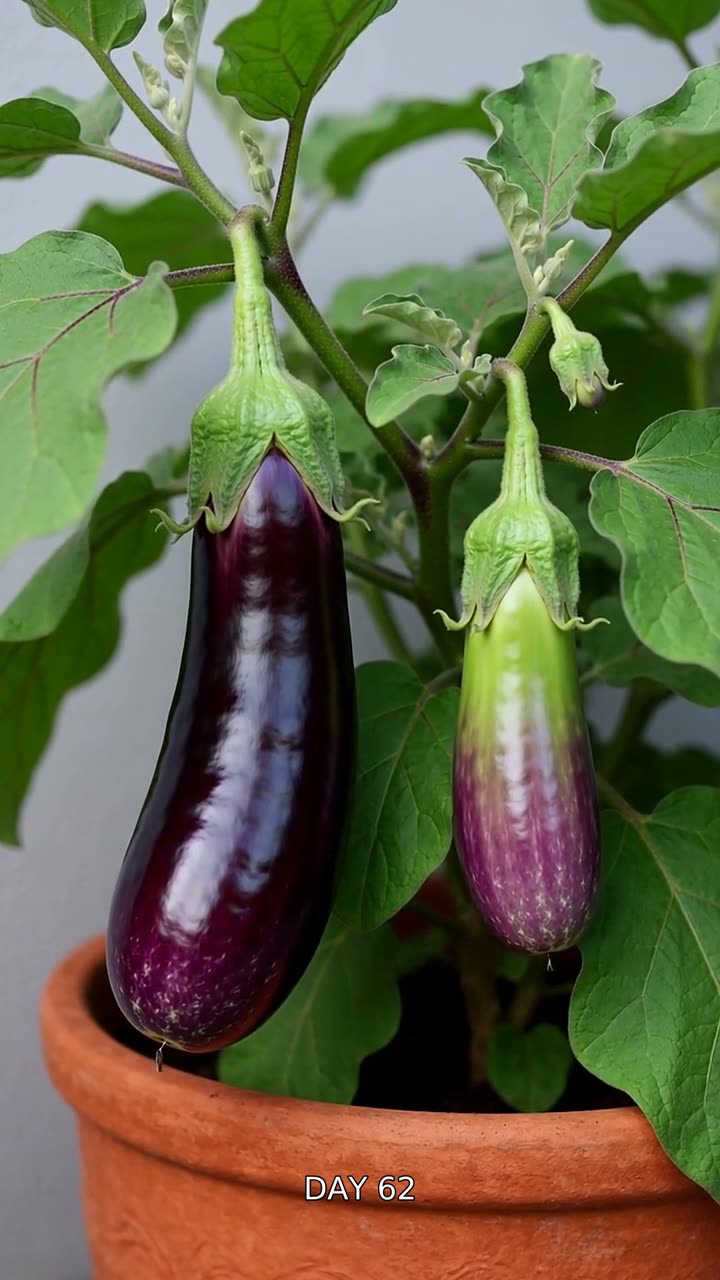
| Fruit development | Around Day 55–72 | In the film, fruit swell, turn deep purple and glossy, and by Day 72 hang at harvest size. |
Warmth is not optional
Eggplant is one of the most cold-sensitive vegetables in a summer garden. Clemson Extension states that eggplant grows best when temperatures are between 70 and 85°F, that it generally has a long growing season, and that it grows slowly during cool periods. Seeds germinate quickly at soil temperatures between 70 and 90°F in that guide. The University of California germination chart gives a tighter optimum of 75 to 85°F for eggplant, with emergence in about 5 to 8 days near the warm end and about 13 days at 68°F. Cool mix does not just delay the seedling — it delays the whole season for a plant that already needs a long one.
That is why both Clemson and the University of Maryland Extension tell growers to start with transplants rather than direct sowing in most home gardens. Clemson recommends setting out 6 to 8-week-old transplants after the last chance of frost and after the soil has thoroughly warmed. Maryland recommends 8 to 10-week-old transplants, planted after danger of frost when the soil is thoroughly warm, in full sun with at least 6 hours of direct light and preferably 8 to 10 hours. If you start your own seed, count backwards from warm soil, not from the last frost date alone. A plant set out into cold soil can sit still for weeks. For what happens inside any seed in this first stage, see How Seed Germination Works.
Spacing, feeding and support
Eggplant becomes a substantial, branching plant, and crowding it costs airflow and fruit size. Maryland Extension gives spacing of 18 to 24 inches in the row with 30 to 36 inches between rows, and notes a high requirement for nutrients. Clemson gives wider field spacing — plants 2 to 2.5 feet apart in rows 3 to 4 feet apart — and advises maintaining soil pH between 6.0 and 6.5 based on a soil test. The two guides differ because one is written for home beds and the other for garden rows, but the shared lesson is the same: do not plant eggplant at pepper spacing and expect a full canopy to stay healthy.
Maryland also offers a shaping tip that matches the film’s middle section: when plants are about 12 inches tall, nip back the growing tip to encourage branching, and support plants with cages or a trellis. A fruit-laden branch is heavy, and support is easier to add young. Clemson adds that the critical period for soil moisture is during fruit set and development, and that mulching helps keep it consistent.
When is it ready? Gloss is the signal
Beginners often wait for a certain size, then pick too late. Extension guidance points to appearance instead. Maryland says to cut fruit at about two-thirds of maximum size, when the skin is very glossy and a thumbnail pressed into the side leaves an indentation. Clemson gives the same test and warns to harvest before the flesh becomes tough and the seeds harden. Dull skin and brown seeds mean an over-mature, bitter fruit. In the film, by around Day 62 the fruit shows exactly that high gloss — your real harvest cue.
Compare eggplant’s pace with Chili: The 158-Day Journey, and if a seed tray sits silent, work through Why Your Seeds Didn’t Germinate. More journeys are on the Seed-to-Harvest Lab home page.
Sources
- Clemson University Cooperative Extension, Home & Garden Information Center — Eggplant — https://hgic.clemson.edu/factsheet/eggplant/
- University of Maryland Extension — Growing Eggplant in a Home Garden — https://extension.umd.edu/resource/growing-eggplant-home-garden
- University of California Agriculture and Natural Resources, Sacramento County Master Gardeners — Soil Temperature Conditions for Vegetable Seed Germination (GN 154) — https://ucanr.edu/sites/sacmg/files/164220.pdf