Chili: The 158-Day Journey
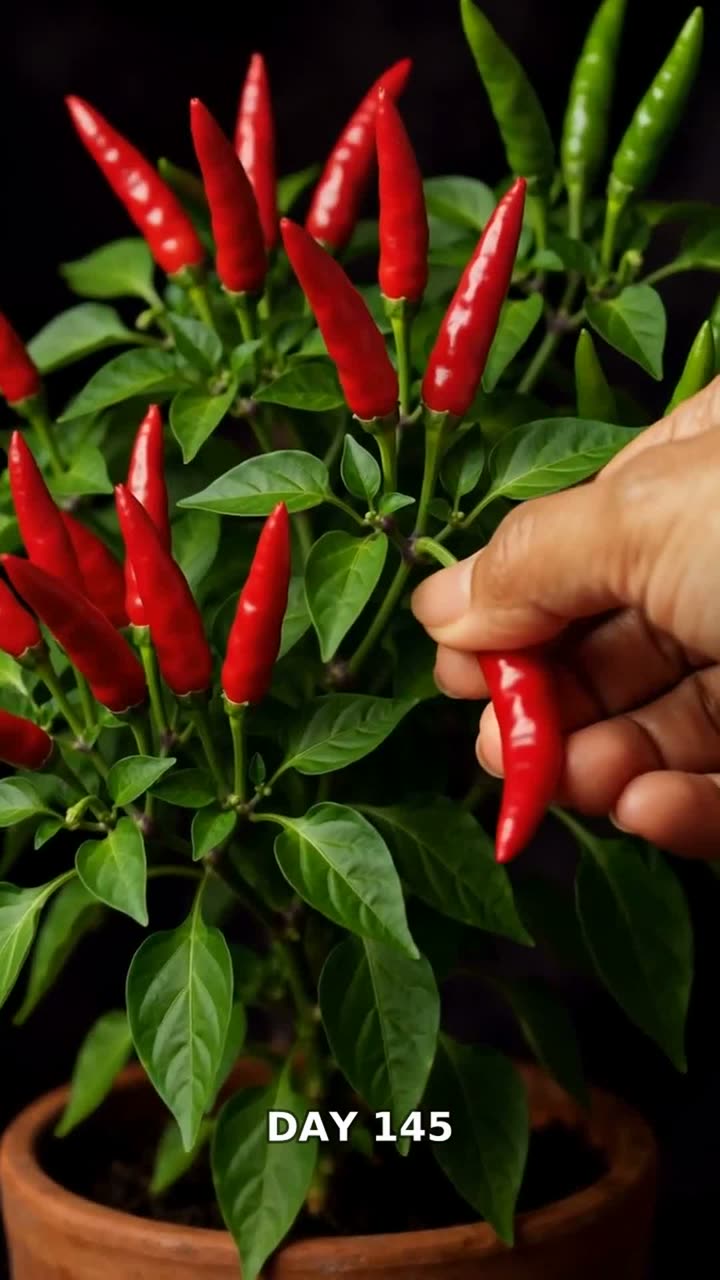
Chili is the slowest story in this series, and that is the point. The Grow Through Time film follows a chili plant for 158 days — seed to red fruit — because hot peppers do not hurry. They need an early indoor start, steady heat, a long frost-free season, and extra weeks after full size just to change color. This page explains where all that time goes.
The honesty note: 158 days is the AI time-lapse’s own span. It reflects a real truth — chilies are a long-season crop — but it is not a guaranteed timeline. A small-fruited chili in a hot climate finishes sooner; a superhot type in a cool summer may need longer. Variety and weather set the real calendar.
Stage by stage: where 158 days go
| Stage | In the film | What you see |
|---|---|---|
| Germination | Day 1–14 | In the film, the seed is slow to move, then a root and a small seedling emerge. |
| Seedling indoors | Around Day 14–55 | In the film, the plant builds true leaves and a compact stem under light, long before outdoor planting is safe. |
| Vegetative growth | Around Day 55–90 | In the film, by around Day 70 the plant branches into a small, thick-canopied bush. |
| Flowering | Around Day 90–115 | In the film, small white flowers open and leave tiny green fruit behind. |
| Fruit growth | Around Day 115–140 | In the film, green chilies lengthen to full size while still unripe. |
| Ripening | Around Day 140–158 | In the film, the fruit turns red, patch by patch, to a full red harvest. |
Germination: chilies want it hot
Pepper seed is famously slow, and temperature is the main reason. University of Minnesota Extension tells growers to use a heating mat to keep the seed flat at 80 to 90°F until seedlings emerge, with 70°F ideal once they are up. The University of California chart puts numbers to the delay: about 25 days to emerge at 59°F, about 12.5 days at 68°F, and about 8 days at 77 to 86°F. A tray on a cold windowsill is not failing — it is running at half speed.
Minnesota Extension also gives the rule that shapes the whole chili calendar: start seed indoors about eight weeks before planting outside — earlier than tomato seed. South Dakota State University Extension gives the same head start. Sow about 1/4 inch deep in sterile, soilless mix, keep it evenly moist, and give seedlings bright overhead light so stems do not stretch. If seeds sit for two weeks, check the mix temperature before sowing more. How Seed Germination Works shows what the seed is doing during that invisible wait.
A long, frost-free season is the requirement
South Dakota State University Extension describes peppers as heat-loving vegetables that require a long, frost-free season and full sun. Minnesota is equally direct: set plants out only after nighttime lows are above 50°F, space them 18 inches apart in rows 30 to 36 inches apart, and expect dry soil, temperatures above 90°F, or nights below 60°F or above 70°F to weaken growth and flower set. Chilies want steady warmth, not extremes.
That need is stronger for hot types than for sweet peppers. SDSU Extension puts days to harvest at 65 to 85 days for peppers as a group, from transplant. Hot and superhot varieties sit at and beyond the long end of that range, because fruit needs extra time to ripen after reaching size. Do not plan a habanero-type chili on a bell pepper’s calendar — start hot chilies earliest, in your warmest spot.
Feeding, water and the leafy-plant trap
Two care mistakes recur with chilies: too much nitrogen and uneven water. Minnesota Extension warns that too much nitrogen leads to bushy, leafy plants that are slow to bear fruit, and that peppers do best at soil pH 6.5 to 7. A huge, dark-green plant with few flowers is usually overfed, not underfed.
For water, Minnesota advises soaking the soil thoroughly at least once a week if the plant does not receive one inch of rain, keeping moisture consistent to protect flowers and small fruit, and avoiding overhead sprinkling. SDSU gives the same one-inch average and warns that soggy soil can cause root rot. Consistent moisture also reduces blossom-end rot. Mulch helps, as in Eggplant Growth Stages (Day 1–72).
Green is a size. Red is a decision.
The last stage is the one growers most often cut short. A full-size green chili is usable — Minnesota notes you do not need to wait for red. But full heat and ripe flavor need the ripening weeks on the plant. In the film, that change takes roughly the last two weeks of the 158 days, and longer in cool weather. Harvest by clipping the stem, wear gloves, and wash your hands before touching your eyes — capsaicin is concentrated in the seeds and pale membrane. Keep picking and the plant keeps flowering. When a tray stalls, see Why Your Seeds Didn’t Germinate and the Seed-to-Harvest Lab home page.
Sources
- University of Minnesota Extension — Growing Peppers — https://extension.umn.edu/vegetables/growing-peppers
- South Dakota State University Extension — Peppers: How to Grow It — https://extension.sdstate.edu/peppers-how-grow-it
- University of California Agriculture and Natural Resources, Sacramento County Master Gardeners — Soil Temperature Conditions for Vegetable Seed Germination (GN 154) — https://ucanr.edu/sites/sacmg/files/164220.pdf