Bean Germination Stages, Day by Day (Day 1–25)
A bean seed spends its first days doing everything underground: soaking up water, splitting its coat, sending a root down, then lifting its seed leaves into the light on a bent stem hook. This guide walks through each stage in order, and separates what our time-lapse shows from how long real beans take in your soil.
How to read this guide: two clocks
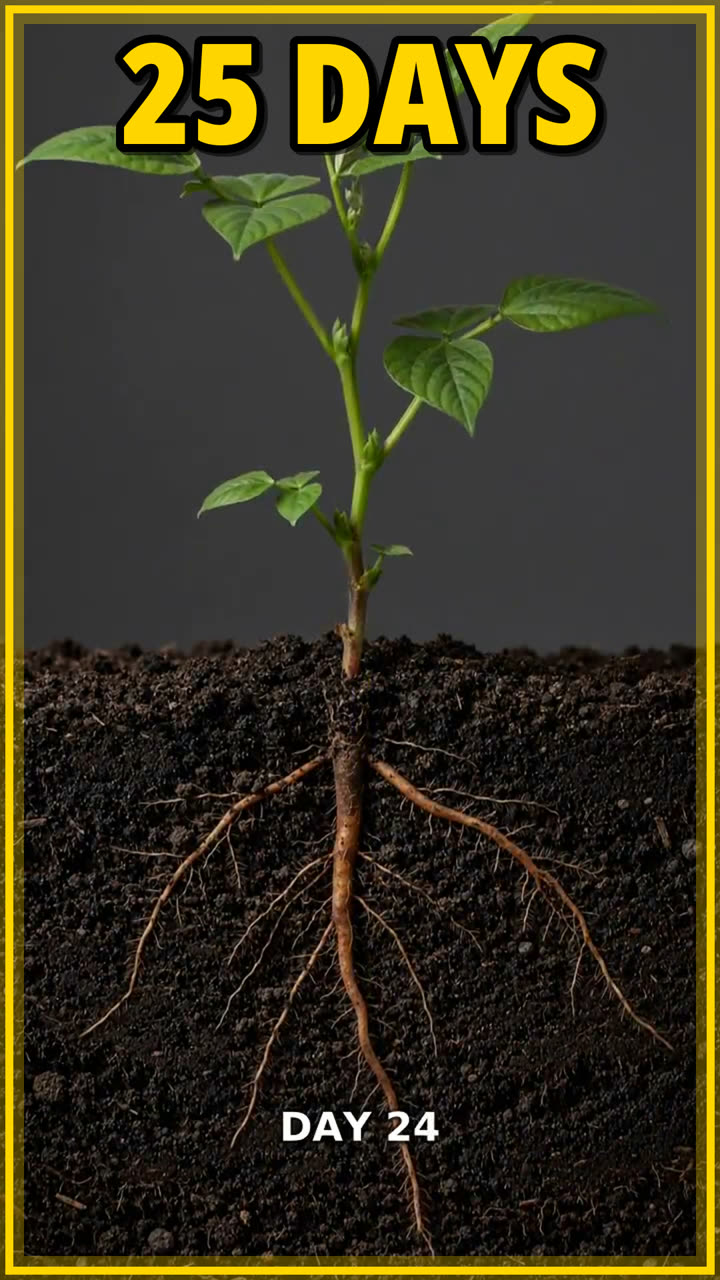
There are two timelines on this page, and keeping them apart matters. The day numbers below come from our 25-day AI time-lapse, which compresses a bean's early life into a teaching sequence — in our 25-day AI time-lapse, Day 1 is sowing day and Day 25 is a young, established seedling. A real bean runs on soil temperature, not on a video script: Oregon State University Extension found bean seedlings took about 16 days to appear at 59°F, 11 days at 68°F, 8 days at 77°F, and 6 days at 86°F. Use the stages to know what is happening; use soil temperature to guess when.
If you want the science behind the stages first, start with How Seed Germination Works — The 5 Stages, then come back here for the bean-specific version.
The stages, in the order the time-lapse shows them
Day 1 — Sowing and imbibition
In our 25-day AI time-lapse, Day 1 is the dry seed going into moist soil. The first real event is invisible from above: the seed absorbs water through its coat — imbibition — and begins to swell. Clemson Extension's snap bean guidance sets the starting conditions: plant beans 1 inch deep, and only once the soil has reached at least 60°F at a depth of 4 inches, because bean seed germinates poorly in cold soil. Bush beans are spaced 2 to 4 inches apart in rows 2 to 3 feet apart.
Days 2–3 — The coat splits, the radicle emerges
Swelling softens and splits the seed coat, and the first root — the radicle — pushes out and turns downward. This root-first order is universal: Purdue Extension describes germination the same way, with the radicle emerging first and the shoot following after. The radicle anchors the seed and starts drawing in water directly, so the seedling is no longer relying only on what soaked in on Day 1. Below ground, small side roots begin to branch off it.
Days 4–6 — Roots build while the shoot wakes up
As roots spread and branch, the food stored in the bean's two thick cotyledons is broken down to pay for growth — the seedling is still spending savings, with no income from leaves yet. The shoot tip, protected between the cotyledons, starts to lengthen. Nothing has broken the surface, which is why this is the stage where impatient gardeners dig seeds up to check — and often damage the root that was doing fine.
Days 7–9 — The hook rises and emergence happens
Beans germinate the epigeal way: the stem below the cotyledons forms a bent hook, pushes up through the soil shielding the growing tip, then straightens in the light and pulls the cotyledons clear of the surface. That moment — the seedling appearing — is what extension timing tables actually measure. Oregon State's figures above (6 days in warm soil, up to about 16 in cool soil, from seed planted at a depth of one-half inch in their trial) are days to this appearance, not days to the radicle, which happened earlier and unseen.
Days 10–14 — Cotyledons open, first true leaves unfold
At the surface the two cotyledons spread apart, green up, and start a little photosynthesis of their own, while the first true leaves — the bean's recognisable trifoliate leaves begin with a simple first pair — unfold from the shoot tip between them. This is the handover: each day, more of the plant's energy comes from light and less from the shrinking cotyledons.
Days 15–25 — Establishment
In the final stretch of our 25-day AI time-lapse, the seedling becomes a young plant: the stem thickens, roots keep branching, new leaves expand, and the spent cotyledons wither and drop. Germination is long finished — the plant is now growing and feeding itself. For a full-season example in this same format, see How Peanuts Grow, another legume with a surprising underground act.
| Soil temperature | Days until bean seedlings appear* | What it means for you |
|---|---|---|
| 59°F | About 16 days | Slow — seed sits a long time at risk of rot; near the 60°F minimum |
| 68°F | About 11 days | Workable, but patience required |
| 77°F | About 8 days | Inside the optimum range — the normal expectation |
| 86°F | About 6 days | Fast emergence, fewer days exposed underground |
*Figures from Oregon State University Extension's germination trials (seed planted one-half inch deep). Oregon State lists 60°F as the minimum soil temperature for bean germination, 60–85°F as the optimum range, and 95°F as the maximum.
If your beans are not following the script
A stage that stalls is information, not just bad luck. Seed that never swells, roots that rot, hooks that never surface, and seedlings that collapse the day after emerging each point at a different cause — cold soil, old seed, wrong depth, too much water, or damping-off disease. Work through them in order in Why Your Seeds Didn't Germinate — A Stage-by-Stage Diagnosis before you re-sow.
Keep exploring
- How Seed Germination Works — The 5 Stages, Seen From Inside the Soil
- Why Your Seeds Didn't Germinate — A Stage-by-Stage Diagnosis
- Tomato From Seed to Harvest — Day-Count Journey
- Seed-to-Harvest Lab — home
Sources
- Oregon State University Extension — Soil temperature conditions for vegetable seed germination — https://extension.oregonstate.edu/catalog/soil-temperature-conditions-vegetable-seed-germination
- Clemson University Extension, Home & Garden Information Center — Bush & Pole-Type Snap Beans — https://hgic.clemson.edu/factsheet/bush-pole-type-snap-beans/
- Purdue University Extension — Corn Germination (imbibition and the radicle-first emergence sequence) — https://ag.purdue.edu/department/btny/ppdl/potw-dept-folder/available/corn-germination.html