Growing a Giant Pumpkin (Day 1–150)
Every other journey here is about growing a plant. This one is about growing a single fruit. The Grow Through Time film follows an Atlantic Giant for 150 days, and its turning point is not a flower — it is the moment the grower prunes the plant down to one fruit and lets that pumpkin have everything. This page explains the space, feeding and pruning a real giant demands.
The honesty note: Day 1–150 is the AI time-lapse’s own span. Real timing is close but not identical — Johnny’s Selected Seeds lists 120 days to maturity from direct seeding, and the fruit keeps gaining weight after that. Your season and soil decide where your plant lands. What does not change is the method: one plant, a lot of ground, one chosen fruit.
Stage by stage: one seed to one giant
| Stage | In the film | What you see |
|---|---|---|
| Germination | Day 1–10 | In the film, a large, flat seed splits and a thick seedling pushes up. |
| Early vine growth | Around Day 10–40 | In the film, plate-sized true leaves appear and the main vine begins to run. |
| Vine expansion | Around Day 40–70 | In the film, by around Day 55 the plant covers serious ground with vines and large leaves. |
| Flowering and fruit set | Around Day 70–90 | In the film, yellow flowers open and several small pumpkins form. |
| The prune to one fruit | Around Day 90 | In the film, the grower removes every young fruit but one; all growth now flows to a single pumpkin. |
| Rapid swelling | Around Day 90–135 | In the film, the chosen fruit expands daily and deepens to orange. |
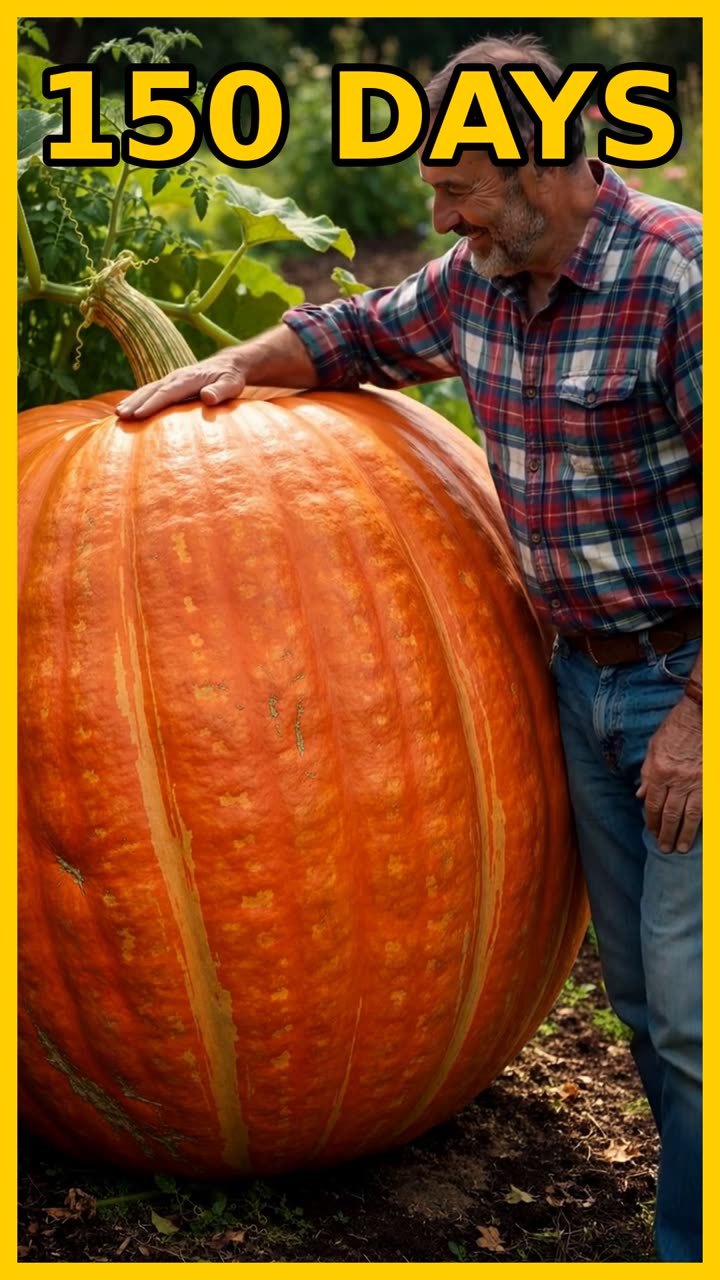
| Harvest | Around Day 150 | In the film, the giant is too heavy to lift — strapped and moved on a pallet beside the gardener. |
Start warm, give it a field, not a corner
Atlantic Giant is Cucurbita maxima, bred by Howard Dill of Nova Scotia — a warm-season crop with no frost tolerance. Johnny’s Selected Seeds advises direct seeding in late spring when soil is at least 70°F, sowing 2 seeds about 1/2 to 1 inch deep and thinning to one plant; for transplants, germinate at 75 to 95°F and handle seedlings with minimal root disturbance. Botanical Interests gives 7 to 14 days to emerge, sowing 2 to 4 weeks after last frost at soil 70 to 90°F, on vines running 15 to 20 feet.
Space is the second non-negotiable. Johnny’s states the formula: fertile soil, irrigation, wide spacing of 70 or more square feet per plant, and limiting each plant to one fruit commonly results in 200 to 300-pound pumpkins; 50 to 100-pounders are commonly grown without that full treatment. Competition growers go further — the Prince Edward County guide describes one plant occupying 500 to 800 square feet or more. Do not plant an Atlantic Giant at ordinary spacing and expect a giant. For a crop using underground space, see How Peanuts Grow.
The twist: prune to one fruit
The film’s central act is standard giant-grower practice, not a camera trick. Johnny’s builds it into the variety description — limiting each plant to one fruit is part of how 200 to 300-pound results are achieved. The Prince Edward County guide explains why: pruning concentrates resources into a single fruit, tertiary vines rob the pumpkin and reduce daily weight gains, and established growers can spend up to an hour a day pruning and burying vines on one plant.
In practice: let the plant set several small fruit, then choose the fastest-growing, best-positioned one on the main vine. Remove every other fruit and keep removing new female flowers. Allow a managed set of secondary vines, remove tertiary vines as they appear, and bury vine nodes so the vine roots at extra points. It feels ruthless to cut off a healthy small pumpkin — the film shows the result: one fruit that never has to share.
Feeding, water and protecting the fruit
A giant pumpkin is a heavy feeder on fertile, well-drained soil. Johnny’s gives the preferred soil pH as 5.8 to 6.8, recommends plastic mulch and row covers at the seedling stage, and warns that poor fruit development may indicate insufficient pollination — growers hand-pollinate the flower they intend to keep. Keep water deep and consistent: a fast-gaining fruit cracks when a dry spell is followed by a flood, and rots on wet soil. Slide a board under the young fruit early, while it is still liftable.
Harvest: plan it before the fruit is too big to move. Johnny’s advises clipping the handle close to the vine when color is fully developed, never lifting by it, and curing in the field for 5 to 7 days or indoors at 80 to 85°F. In the film, by around Day 150 the pumpkin is strapped and lifted on a pallet.
If this scale is more than your garden allows, start with Sunflower in 84 Days for a giant in a few square feet, or How Potatoes Grow Underground for a hidden harvest. All journeys are on the Seed-to-Harvest Lab home page.
Sources
- Johnny’s Selected Seeds — Atlantic Giant (F1) Pumpkin Seed — https://www.johnnyseeds.com/vegetables/pumpkins/giant-pumpkins/atlantic-giant-f1-pumpkin-seed-4428.html?cgid=giant-pumpkins
- Botanical Interests, via Mahoney’s Garden — Pumpkin, Atlantic Giant Seeds (variety and sowing information) — https://shop.mahoneysgarden.com/product/botanical-interests-pumpkin-atlantic-giant-seeds/
- Prince Edward County Pumpkin Growers, by Russ Landry — Pruning Atlantic Giant Pumpkins for Competition — http://www.pec.on.ca/pumpkinfest/NewsletterFall11.pdf