How Potatoes Grow Underground (Day 1–90)
Potatoes do not grow on roots. A new potato is a swollen underground stem — a tuber — that forms at the tip of a thin stem called a stolon, in darkness below the soil. This guide follows that hidden process, from a planted seed piece to harvest.
The short answer: a potato is a stem, not a root
The University of Maryland Extension puts it plainly: tubers are enlarged, modified stems — not roots — that develop at the ends of underground stems called stolons. The true roots have a different job: they anchor the plant and take up water and nutrients. They never swell into potatoes.
You can see the proof on any potato. The “eyes” are buds set in nodes, just as buds sit on an above-ground stem. Roots do not have buds like that. Each eye can sprout a whole new plant, which is why potatoes are planted from pieces of tuber rather than ordinary seed. For the contrasting true-seed route, see how seed germination works.
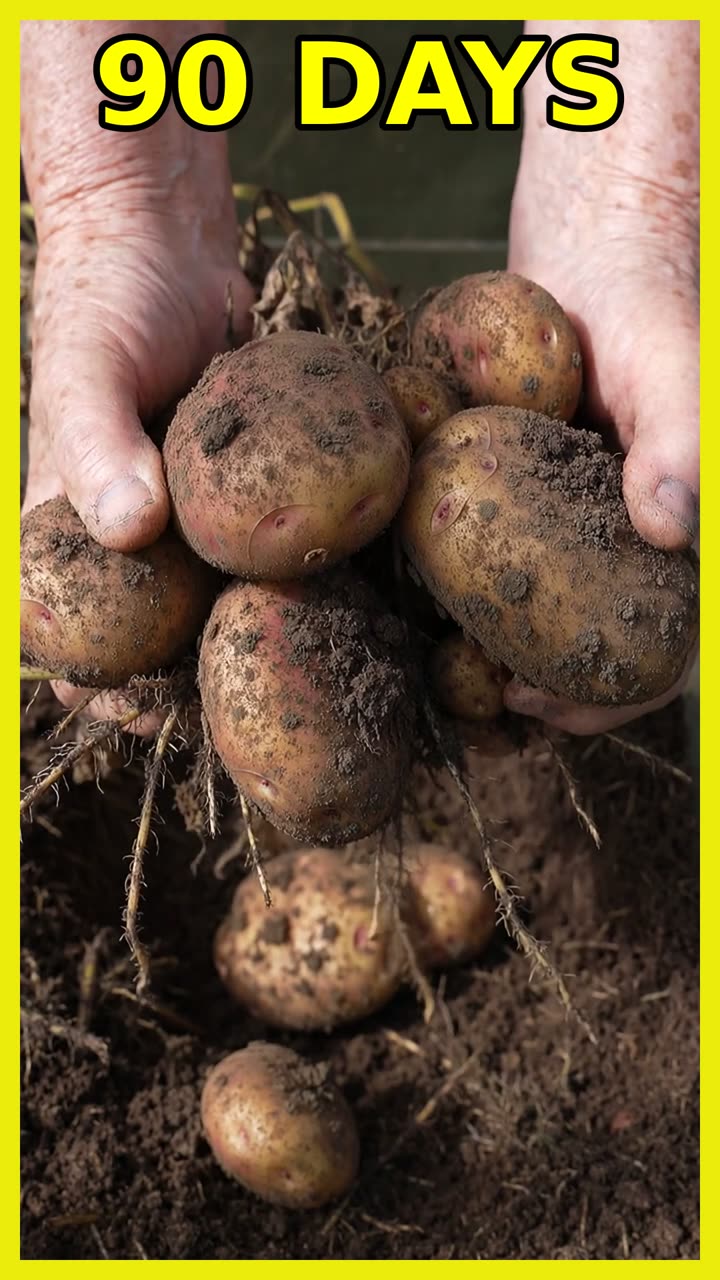
What you actually plant: a seed piece
“Seed potatoes” are not botanical seed. You plant a piece of tuber. Maryland Extension recommends pieces of about 1½ to 2 ounces, roughly 1½-inch cubes, each with one to three eyes, bought as certified disease-free stock. Clemson Extension adds that pieces should be cut three to five days before planting so cut surfaces can heal.
- Buy certified stock. Maryland and Clemson both warn against grocery-store or saved tubers, which can carry disease without showing symptoms.
- Plant in cool soil. Maryland says soil temperature should be at least 45°F at planting; North Dakota State University Extension likewise says above 45°F.
- Depth and spacing. Plant cut side down 3 to 5 inches deep — later crops 5 to 6 inches deep — spaced 8 to 12 inches apart in rows 24 to 36 inches apart (Maryland). Minnesota Extension gives a close match: 10 to 12 inches apart, 3 to 5 inches deep, rows 30 to 36 inches apart.
- Too hot inhibits tubers. Maryland notes soil temperature in excess of 80°F will inhibit tuber development — one reason potatoes are a cool-season crop.
At first, the stored starch in the seed piece feeds the sprout, until the young plant builds leaves and roots of its own.
Stage by stage: above ground vs. below ground
The day labels follow our 90-day AI time-lapse for orientation. Real-world timing in the text comes from the extension sources below, and real gardens vary by variety and weather.
| Stage | Above ground | Below ground |
|---|---|---|
| Planting | Nothing visible; the bed looks empty. | A seed piece sits 3 to 5 inches deep, living on stored starch. |
| Emergence | A sprout from an eye pushes up and opens leaves. | True roots grow out for water and nutrients. |
| Stolon growth | Stems grow bushier; growers start hilling. | Stolons grow sideways from the main stem, near the seed piece. |
| Tuber initiation | Plants may flower. Maryland times a side-dressing to about six weeks after planting, when tubers begin to form. | Some stolon tips stop lengthening and begin to swell — the first young tubers. |
| Tuber bulking | Leaves send sugars down; steady watering matters most now. | Tubers enlarge. Tender “new” potatoes can be dug about six to eight weeks after planting (Maryland); Minnesota says about seven to eight weeks. |
| Maturation | Vines yellow and die back. | Skins thicken. For storage, Maryland advises leaving tubers two weeks after die-back so skins set. |
Why the stolon detail matters
Minnesota Extension explains that the plant will grow more stolons if more of the main stem is underground. That single fact is the whole logic behind hilling.
Why gardeners hill potatoes
Hilling — mounding loose soil around the stems — buries more stem for stolons to form from, and keeps developing tubers in darkness. Minnesota says to start when stems are about a foot tall, repeat once or twice more, and build six to eight inches in total, so shallow tubers are not exposed to light and do not turn green. Maryland adds that green portions are associated with solanine, a bitter, toxic compound to cut out and discard; Clemson says green portions are poisonous and taste bitter. A green potato is not an unripe potato — it is a light-exposed tuber, and hilling prevents it.
How long does it really take?
In our 90-day AI time-lapse, the story is compressed into a Day 1–90 arc. Treat that as the video’s own span, not a garden promise. In the real world, Maryland lists days to maturity at 90 to 120, and Clemson says potatoes average 100 to 120 days to maturity. Maryland warns that too much or too little water is linked to cracks and misshapen tubers, and Clemson notes water is critical when blossoms are forming. If a planting stalls in cold, wet soil, why seeds don’t germinate covers the conditions that also make seed pieces sit and rot.
Common misunderstandings
- “Potatoes grow on the roots.” No — they form at stolon tips. Roots only feed the plant.
- “The flowers become potatoes.” No — the harvest forms underground on stolons; above-ground flowers and fruit are separate.
- “Deeper planting is always better.” No — the guides keep planting at 3 to 5 inches and add soil later by hilling.
For a crop that hides its harvest the opposite way, read how peanuts grow, and for an above-ground contrast see the giant pumpkin journey.
Keep exploring
- How peanuts grow — the flower that buries itself
- Bean germination stages, day by day
- Seed-to-Harvest Lab home
Sources
- University of Maryland Extension — Growing Potatoes in a Home Garden — https://extension.umd.edu/resource/growing-potatoes-home-garden
- University of Minnesota Extension — Growing potatoes in home gardens — https://extension.umn.edu/garden-and-home/yard-and-garden/gardening-in-minnesota/growing-potatoes
- Clemson Extension, Home & Garden Information Center — Potato — https://hgic.clemson.edu/factsheet/potato/
- North Dakota State University Extension — Field to Fork: Potatoes! — http://miv.ext.nodak.edu/agriculture/extension/publications/field-fork-potatoes