The Flower That Buries Itself — How Peanuts Grow (Day 1–120)
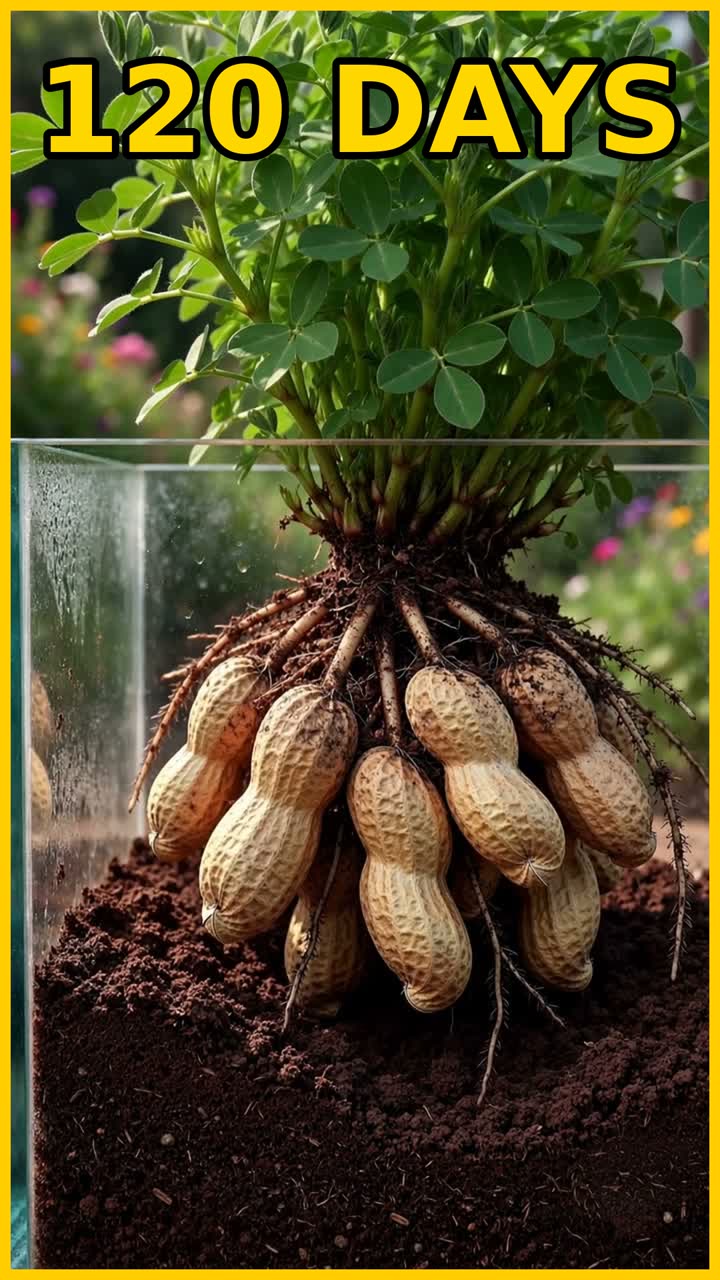
A peanut plant flowers in the open air — then does something almost no other crop does. After fertilisation, it grows a stalk called a peg that pushes the future fruit down into the soil, where the pod and seeds develop underground. Botanists call this geocarpy: fruiting below the ground.
First, clear up the biggest misunderstanding
The yellow flower does not “turn into” a peanut, and it does not travel underground itself. Clemson Extension describes the real sequence. The peanut is self-pollinating, and its flowers open above ground in the leaf axils. When a flower is fertilised, the ovary at its base elongates into a new structure: the peg. The flower withers, the peg grows downward with the ovary at its tip, and only after that tip is buried does it swell into a pod.
So a peanut pod is not a root or a tuber. It is a true fruit — a legume pod — that matures underground. Compare how potatoes grow underground, where the harvest is a stem tuber and flowers barely matter. Peanuts are the mirror image: no flower, no peg, no peanut. If the seed stage fails, see why seeds don’t germinate.
Stage by stage: above ground vs. below ground
Clemson describes the peanut as a low, yellow-flowered bush, slightly higher than 1 to 2 feet tall with about a 3-foot spread. Day ranges below are Clemson’s real-world ranges; our video compresses its story into a 120-day AI time-lapse, explained below.
| Stage | Above ground | Below ground |
|---|---|---|
| Emergence (about 5–10 days) | Under optimum conditions the seedling “cracks” through the surface in 5 to 10 days from planting. | The seed germinates in warm soil — Clemson says germination is best between 68 and 95°F — and a taproot anchors the plant. |
| Early growth (to about Day 40) | Plants grow slowly until about 40 days, then faster, with a four- to five-fold increase in foliage between about 40 and 100 days. | Roots spread and form nodules where Rhizobium bacteria convert nitrogen from the air into a form the plant can use. |
| Flowering (about 25–40 days) | Small yellow flowers open in the leaf axils and pollinate themselves, over many weeks. | Nothing to harvest yet — every future pod starts as an above-ground flower. |
| Pegging | Fertilised flowers wither; pegs are first visible about one week after fertilising and bend toward the soil. | About 8 to 12 days after pollination, pegs enter the soil to a depth of 1 to 2 inches, carrying the developing fruit at the tip. |
| Pod development | The bush keeps flowering; do not disturb soil under the branches once pegging begins. | The buried peg tip begins to enlarge into a pod soon after entering the soil, if water and calcium are present. |
| Maturation | Plants are lifted whole, pods still attached. | Green, boiling peanuts mature in 90 to 110 days; dry, roasting peanuts take 130 to 150 days. |
Pegging, step by step
1. The peg has to reach the soil
A peg that cannot penetrate the ground cannot make a pod. Clemson advises a deep, loose seedbed, tilled to 8 to 12 inches with clods broken up. Hard or crusted soil blocks the one move the crop depends on — and cultivating under the branches after pegging starts can break the pegs you want to protect.
2. The pod develops in darkness, at the peg tip
Once the tip is buried, elongation stops and the fruit enlarges into the ridged pod, seeds forming inside. Because flowers open over a long season, pods on one plant are different ages. Clemson notes early pegs near the taproot mature sooner than later pegs farther away — so maturity is judged by opening sample pods, not by the calendar alone.
3. Water matters most while pegs and pods form
Clemson lists three critical moisture periods: at planting; from 60 to 110 days, as pegs enter and pods develop — “water is most critical at this time”; and during pod filling, from about 110 days until harvest. Stop irrigating 10 days to two weeks before harvest.
The calcium twist: pods feed themselves
For calcium, peanuts break the usual rule that roots deliver everything. North Carolina State Extension explains that a high concentration of calcium is needed in the pegging zone — the upper two to three inches of soil — because calcium moves into pegs and pods with soil water, and the plant cannot provide adequate calcium through its leaves or roots. The buried pod absorbs calcium directly from surrounding soil.
Clemson agrees: foliar calcium is not effective for peanuts, deficiency results in unfilled pods, and Virginia types need more calcium than smaller-seeded varieties. Growers therefore apply gypsum at flowering and pegging, so calcium sits in that shallow zone when pods need it (NC State Extension). Without it, you can get “pops” — formed pods with no proper kernel inside.
Growing peanuts at home: the numbers that matter
- Depth and spacing. Plant seeds 2 to 3 inches deep in light, sandy soils and 1½ to 2 inches deep in clay soils, sow five seeds per foot of row, and space rows at least 20 inches apart (Clemson).
- Soil pH. Peanuts prefer a pH between 5.8 and 6.2 (Clemson), decided by soil test — the same test should drive lime and gypsum decisions.
- Checking maturity. Begin checking 15 to 20 days before the expected harvest date (Clemson), lifting a few plants and opening pods.
- About our 120 days. In our 120-day AI time-lapse the story runs Day 1–120 for teaching. That sits inside the real range for green peanuts and at the early edge for dry, roasting peanuts — it is the video’s own span, not a garden guarantee.
New to seed starting? Begin with bean germination stages and how seed germination works.
Keep exploring
- How potatoes grow underground — stolons, not roots
- Giant pumpkin journey — 150 days above ground
- Seed-to-Harvest Lab home
Sources
- Clemson Extension, Home & Garden Information Center — Peanut — https://hgic.clemson.edu/factsheet/peanut/
- NC State Extension — Application of Gypsum Prior to Planting Versus Pegging, Peanut Notes No. 38 (2026) — https://peanut.ces.ncsu.edu/news/application-of-gypsum-prior-to-planting-versus-pegging-peanut-notes-no-38-2026/
- NC State Extension — Peanut Grower Magazine Comments, Peanut Notes No. 103 (2026) — https://peanut.ces.ncsu.edu/news/peanut-grower-magazine-comments-peanut-notes-no-103-2026/
- Virginia Tech, Tidewater AREC — 2025 Peanut Production Guide — https://www.arec.vaes.vt.edu/content/dam/arec_vaes_vt_edu/tidewater/2025-production-guides/2025%20Peanut%20Production%20Guide%202025SPES-652NPspread.pdf